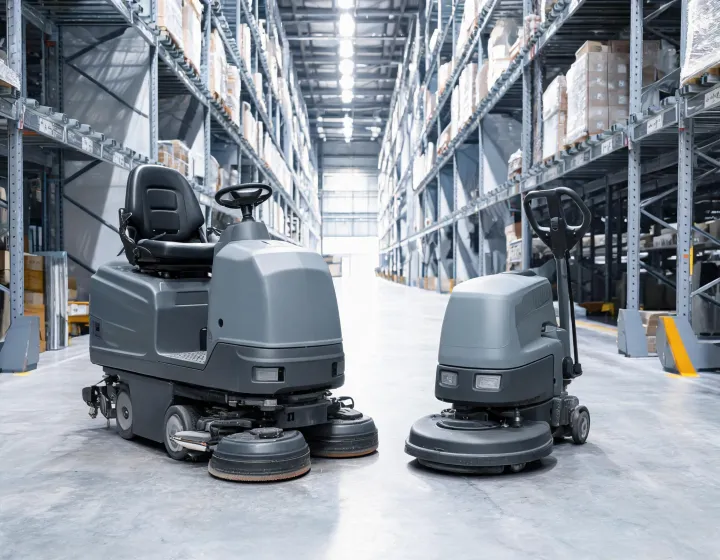
Process and technology selection
Ride On Floor Scrubber
A ride on floor scrubber is a different operating envelope from a walk-behind deck. Choose the technology by aisle width, area, and who sits or walks, then ask factories to quote that choice. This page records the trade-off. It does not approve a model.
Compare Proposed SpecificationsTrade-off matrix for the exact proposed unit
Fill both columns with supplier answers. A blank cell stays blank. Product-family pictures are not measurements.
| Decision field | Walk-behind question | Ride-on question |
|---|---|---|
| Cleaning path | Inches of deck the walking operator can keep on the soil line | Inches of deck plus the machine width past the deck |
| Working envelope | Handle, squeegee, and turning space in the narrowest door | Seat, steering, and turning radius against rack spacing |
| Throughput | Square feet per hour at a stated walk speed and overlap | Square feet per hour at a stated travel speed and overlap |
| Power and duty | Battery volts or cord, runtime hours, charger input voltage | Battery pack volts, duty cycle of the traction drive, charger circuit |
| Service access | Blade and pad changes from a standing position | Access under the seat or deck without a second lift plan |
| Noise level | dBA, distance, and mode for a walking machine | dBA, distance, and mode with traction engaged |
Standard deck versus a site-specific deck
A standard configuration reduces the document set: one path, one tank pair, one voltage. It loses when the doorway, the ramp, or the chemical is outside that configuration. An application-specific deck can add a narrower squeegee, a different pad driver, or a charger matched to the panel. Each addition is a specification deviation with its own price and lead-time effect. Write which deviations are acceptable before the RFQ goes out.
Headline rating versus the test basis
Runtime in hours is meaningless without the mode: scrub pressure, solution flow, and whether traction on a ride-on unit was included. Noise is meaningless without distance. Tank gallons are meaningless if solution and recovery are added together. Ask the supplier to attach the method to the model code on the quotation.
Purchase price versus lifecycle scope
A ride-on machine often carries a higher equipment number and a higher square-foot rate under a stated speed. That comparison collapses if pads, batteries, freight, and commissioning are in one offer and missing from the other. Delivered cost uses the same Incoterm, the same quantity, and the same destination. This desk does not publish a savings figure.
Continue with the catalog labels, the industrial quote stack, and the evidence article.
RFQ questions while the technology is still open
Can one RFQ ask for both technologies?
Yes, as two named alternatives. Keep quantity, destination, and floor description identical. Ask each factory to price walk-behind and ride-on on separate lines so the control interface, charger, and spare parts list are not blended.
What budget note is useful this early?
An optional range with currency and a per-unit or whole-order basis. "Not sure" is a valid supplier preference. It means the buyer wants the documentation and the commercial posture compared, not that a factory has been graded.
Which files travel with the opening message?
Aisle width, doorway width, floor type, shift length, and the electrical panel available for the charger. Drawings can follow. The form does not accept an upload. Unknowns should be labeled unknown rather than copied from a catalog photo.
Technology: ride on floor scrubber, walk-behind, or both as alternatives. Add quantity and the US destination.
Request Factory Quotes